What’s Actually Included in a Long Distance Moving Quote?
A line-by-line breakdown of what a long distance moving quote actually covers. Compares binding and non-binding estimates, volume and weight pricing, accessorial charges like shuttle and long carry, packing service tiers, and federal valuation options, plus an 8-point checklist for reviewing any interstate moving estimate before you sign. [...]<p><a class="btn btn-secondary understrap-read-more-link" href="https://crosscountrymovers.com/resources/understanding-your-long-distance-moving-quote/">Read More...</a></p>

Most people read a moving quote the way they read a terms-of-service page. Scroll, scroll, sign. Then the truck shows up and there’s a shuttle fee nobody mentioned.
Here’s the thing: a long distance moving quote is not a price tag. It’s a scope document. The number at the bottom only means something if you know exactly what’s above it.
This guide walks the whole thing line by line, in plain language, so you can tell the difference between a real flat rate and a lowball number designed to grow later.
The Short Answer: What a Long Distance Moving Quote Covers
A standard long distance moving quote covers the labor and transportation to get your inventory from door to door. That's it.
Almost Always in the Base Price
- Loading and unloading by professional movers
- Line-haul transportation between states
- Furniture disassembly and furniture assembly for standard beds, tables, and shelving
- Basic protective materials on the truck: furniture blankets, shrink-wrap, straps
- Released value coverage at 60 cents per pound, required by federal law and free
- Your inventory list and pre-move consultation
Almost Always Priced Separately
- Full-service packing and unpacking services
- Fragile-only packing and specialty boxes
- Custom crating for art, marble, or anything crated for structural reasons
- Storage services, including long-term storage
- Auto transport and vehicle transport
- Appliance moving that requires disconnection or reconnection
- Full-value protection above the federal minimum
- Expedited delivery
- Debris removal and post-move debris cleanup
Everything in that second list is legitimate. None of it is a scam. The problem starts when a company knows you'll need three of those items and quotes you as if you won't.
How Interstate Moving Quotes Actually Get Built
Two companies can quote the same three-bedroom house in Arizona and land $2,000 apart, and both can be honest. The difference is usually the pricing basis.
Volume vs. Weight
Weight-based pricing means your final number depends on what the scale says after loading. You get an estimate up front, then a real number later. Legal, common, and genuinely unpredictable for the customer.
Volume-based pricing (cubic feet) means the number depends on how much truck space your inventory occupies. Once the inventory list is locked, the space is locked.
Cross Country Movers charges by volume, which is why the company can commit to a guaranteed flat price based on a detailed inventory list with no surprise fees or weight-based charges. Add something later and the price gets recalculated before pickup, not after.
Neither method is automatically better. But if you're comparing quotes, comparing a volume quote against a weight estimate is comparing a contract against a forecast.
Binding vs. Non-Binding Estimates
This is the single most important line on your paperwork, and most people skip it.
The Federal Motor Carrier Safety Administration requires interstate movers to give you a written estimate. A verbal quote is not an official estimate. There are two flavors.
Binding estimate. The total is guaranteed for the inventory and services listed. If the mover tries to raise the price, you cannot be required to pay more than 100% of the binding estimate.
Non-binding estimate. An approximation. At delivery you can be required to pay up to 110% of the non-binding number, with any remaining balance billed within 30 days.
So a non-binding quote of $5,000 is really a quote of up to $5,500, and then you talk. A binding quote of $5,400 is a quote of $5,400. Read those two sentences again, because that is the whole game. The underlying rules live in 49 CFR Part 375, and the payment ceilings are spelled out in the FMCSA consumer FAQs.
The Pre-Move Survey
Federal rules expect your mover to base the estimate on a physical survey of your goods, on-site or virtual, unless you waive that in writing.
A virtual in-home price estimate over video is not a shortcut. It's the thing that makes the number real. A company that quotes your entire house off a five-question web form and never asks to see it is quoting a guess, and guesses get corrected on moving day.
Walk the surveyor through the garage. The attic. The closet you were hoping to ignore. Every item you leave off the inventory is a line item someone adds later.

Line Items That Cost Extra and Why
Movers call these accessorial charges. They exist because some jobs require labor or equipment the base rate does not assume. Here is what triggers them.
← swipe to see all columns →
@media (max-width:640px){.ccm-swipe-hint{display:block !important}}
| Service | In base quote? | What triggers the charge |
|---|---|---|
| Loading and unloading | Yes | Included in every full-service move |
| Furniture disassembly and assembly | Usually | Standard items yes; complex built-ins may be extra |
| Full-service packing | No | You want the crew to pack everything |
| Fragile-only packing | No | Dishes, glass, art, mirrors only |
| Specialty boxes and moving supplies | No | Wardrobe, dish-pack, TV, mattress boxes |
| Custom crating | No | Items that must be crated: sculpture, marble, oversized glass |
| Long carry | No | Truck can't park within a set distance of the door |
| Shuttle service | No | Street too narrow for the trailer, common in Los Angeles, Philadelphia, and older parts of New York City |
| Stair or elevator carry | Sometimes | Walk-ups above a certain floor count |
| Storage services | No | Home isn't ready, or you need long-term storage |
| Auto transport | No | Shipping a car instead of driving it |
| Appliance servicing | No | Washer, dryer, or refrigerator needs disconnect or reconnect |
| Expedited delivery | No | You need a guaranteed narrow delivery window |
| Debris removal | No | Boxes and packing material hauled away after unpacking |
| Full-value protection | No | Coverage above the 60-cent federal minimum |
Shuttle Fees: The Most Common Surprise
Shuttle fees are the most common surprise on cross-country moving jobs and the most avoidable. If your street is tight, say so during the survey. A good relocation coordinator will price it in advance instead of discovering it at 8 a.m. on moving day.
Storage: Ask Three Questions First
Ask whether the first month is free, whether the facility is temperature-controlled, and what the monthly rate becomes after that. Cross Country Movers includes a free month of storage in temperature-controlled facilities with no obligation to keep paying for it after.
Packing: Where Quotes Diverge Most
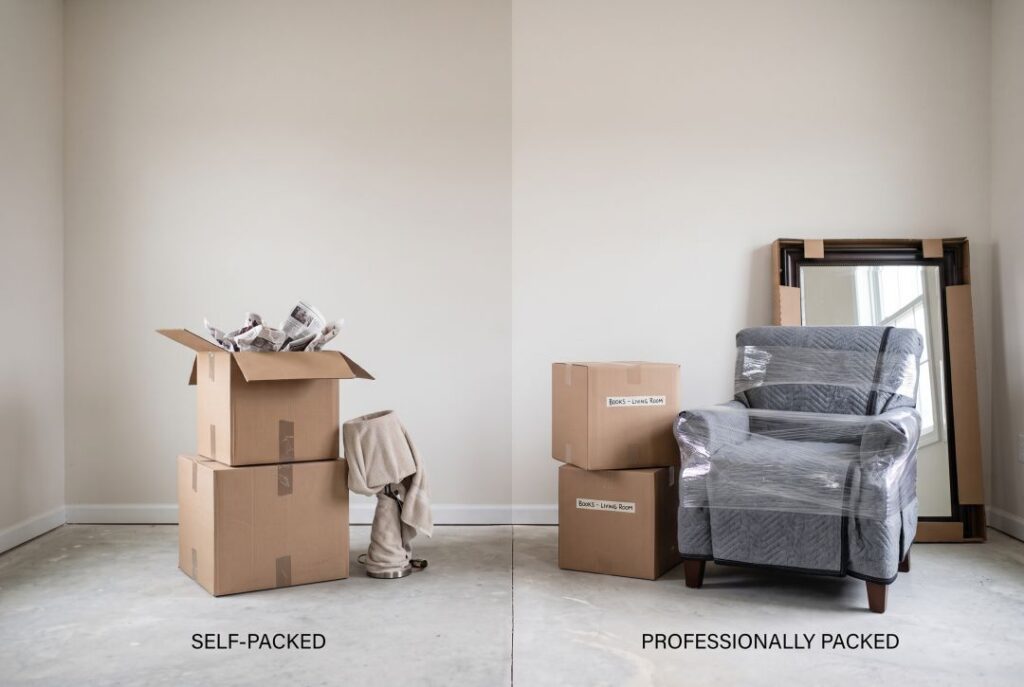
Packing is the biggest single variable in any long distance moving quote. It's also where people talk themselves into a bad decision to save a few hundred dollars.
← swipe to see all columns →
@media (max-width:640px){.ccm-swipe-hint{display:block !important}}
| Self-pack | Fragile-only packing | Full-service packing | |
|---|---|---|---|
| Cost | Lowest | Middle | Highest |
| Your time | Days to weeks | A weekend | A few hours |
| Damage risk | Highest | Low on breakables | Lowest |
| Claim strength | Weakest | Strong on packed items | Strongest |
| Best for | Small apartments, flexible timelines | Most households | Tight timelines, large homes, valuable contents |
Why Self-Packing Weakens Your Claim
That claim strength row is the one nobody thinks about. Federal guidance is direct about it: if you pack your own boxes and the contents are damaged, it may be harder to establish a claim against the mover.
You saved $600 on packing services. The mover's liability for the box you taped shut yourself is now a much harder argument. Sometimes that's still the right trade. Just make it knowingly.
Middle ground works for most people: you pack books, linens, and clothes, and the crew handles kitchen, glass, and art. That's what professional packing services are actually for.
Coverage: The Part Everyone Gets Wrong
"Licensed and insured" doesn't mean your belongings are insured for what they are worth. Under federal law, interstate movers must offer two valuation options.
Released Value Protection
Free, and minimal. The mover is liable for no more than 60 cents per pound per article. A 25-pound television pays out $15.
Full Value Protection
The mover is responsible for the replacement value of lost or damaged goods, and will repair, replace, or settle in cash. Movers may limit liability on items of extraordinary value, meaning anything worth more than $100 per pound, unless you list those items specifically on the shipping documents.
Two Things That Follow
Check which box is ticked. If you don't affirmatively choose Released Value, your shipment moves under full-value protection by default.
List the high-value items in writing. The jewelry, the watch, the signed print. A verbal heads-up to the foreman is not a declaration.
And if something does go wrong, you have nine months from delivery to file a written claim. Photograph everything at pickup. It takes twenty minutes and it's the only evidence you'll ever have.
Compare the moving insurance options before you sign, not after the truck leaves.
Delivery Timelines and Transit Time
Your quote should state a delivery window, not a delivery date. Anyone promising an exact day on a coast-to-coast move without an expedited fee attached is telling you what you want to hear.
Typical transit time on a cross-country route runs 7 to 21 days, with California to New York averaging 10 to 14. Texas to the Northeast tends to land shorter. Routes into rural destinations run longer because the truck is consolidating multiple shipments.
Ask three questions.
- What is the first available delivery date, and how wide is the window?
- Is expedited delivery available, and what does it cost?
- Is there real-time shipment tracking, or do I call for updates?
If you're bridging a gap with temporary housing, that window is the number your whole plan hangs on. Get it in writing.
A 10-Minute Quote Review Before You Sign
Before you sign anything, run this moving checklist against the document in front of you.
The 8-Point Quote Review
- Is it binding or non-binding? Find the words. They're on the form.
- Is the inventory complete? Count the boxes it assumes. Compare to reality.
- Which valuation option is selected? Released value or full-value protection.
- Are accessorials listed or excluded? Shuttle, long carry, stairs, storage.
- What's the delivery window? Not the date. The window.
- Is the company a carrier or a broker? A broker books your move and sells it to another company, and doesn't own trucks or crews. Ask directly.
- Do the USDOT and MC numbers check out? Look them up yourself.
- What's the deposit and cancellation policy?
Verify the Carrier Yourself
You can verify any interstate mover in about thirty seconds on the FMCSA SAFER company snapshot. Cross Country Movers operates as a direct carrier under USDOT 2552260 and MC-889368. Run it. Run everyone else's too.
For a broader look at vetting companies before you get to the quote stage, see what to look for when hiring a long distance moving company. And if you're still working out the budget, the average cost of moving across the country breakdown covers the numbers side.
Where Cross Country Movers Lands on This
Full disclosure on the perspective here: this is published by a licensed interstate carrier, not a neutral review site. So judge the specifics rather than the adjectives.
The pricing model is volume-based and binding, which is the whole basis for transparent pricing here. The inventory list gets triple-checked with you before it's locked. Nationwide moving coverage runs across all 50 states, and the same in-house crews handle residential moving, commercial moving, office relocations, and white-glove handling for high-value pieces.
What That Means on Your Quote
Guaranteed flat price based on a detailed inventory list with no surprise fees or weight-based charges
Experienced movers trained to handle fragile and bulky items with care and attention to detail
Timely pick-up and drop-off respecting clients' schedules for all moves, local or cross-country
Comprehensive services including packing, storage in temperature-controlled facilities, and car shipping
Full-service international moving to over 150 countries including packing and customs documentation
Related Services
Auto transport runs on open or enclosed trailers with vehicle coverage included, which matters if you're doing the Los Angeles to Austin drive and would rather fly. The full scope sits on the long distance moving services page.
Book 6 to 8 weeks out for a standard interstate move, longer for summer. That's not a sales line, it's scheduling reality across the industry.
Key Takeaways
Key Takeaways
- A long distance moving quote is a scope document, not a price. The number only means something alongside the inventory list and service list behind it.
- Binding estimates cap what you pay at 100%. Non-binding estimates can legally reach 110% at delivery, with more billed later.
- Volume-based pricing locks to your inventory. Weight-based pricing locks to a scale reading you won't see until after loading.
- Packing, storage services, auto transport, custom crating, expedited delivery, and debris removal are separate line items nearly everywhere. Get them itemized.
- Free coverage is 60 cents per pound. Full-value protection is the default unless you sign it away, and extraordinary-value items must be listed in writing.
- Shuttle and long-carry fees are the most common surprises, and both are preventable with an honest pre-move survey.
- Verify USDOT and MC numbers yourself before you sign, and confirm whether you're hiring a carrier or a broker.
Planning an interstate move and want a number you can actually hold someone to? Request a free, no-obligation estimate from Cross Country Movers, a licensed and insured direct carrier operating under USDOT 2552260 and MC-889368.
Frequently Asked Questions
- Does a long distance moving quote include packing?
Not by default. Base quotes cover loading, transport, and unloading at destination. Full-service packing, fragile-only packing, unpacking services, and specialty boxes are priced as separate line items. Ask for them itemized so you can add or drop each one independently.
- What is the difference between a binding quote and a regular estimate?
A binding quote guarantees the total for the listed inventory and services, and the mover cannot require more than that amount at delivery. A non-binding estimate is an approximation, and federal rules allow the mover to collect up to 110% of it at delivery. Always confirm in writing which one you have.
- Are hidden fees on interstate moves legal?
Charges that appear on the final invoice are legal if the underlying service was actually performed and the charge type is disclosed in the mover's tariff. The problem is disclosure, not legality. Accessorial charges like shuttle service, long carry, and stair fees should be identified and priced during the pre-move survey, which is exactly why the survey matters.
- Is 60 cents per pound really the standard moving coverage?
Yes, for Released Value Protection, which is the free federal minimum. It pays by weight, not value, so a heavy cheap item is covered better than a light expensive one. If you're not deliberately choosing that option, your shipment defaults to full-value protection instead. Verify which one your paperwork shows on the FMCSA liability and protection page.
- Do I need to be there on moving day?
Yes, at both ends. Someone has to sign the bill of lading, confirm the inventory, and note any exceptions at delivery. If you genuinely can't be present, authorize someone in writing before the crew arrives.