What Should I Look For When Hiring a Long Distance Moving Company? (2026 Guide)
Hiring long-distance movers in 2026? Here is exactly what to look for: FMCSA licensing, binding estimates, full replacement value insurance, real reviews, and the red flags that signal moving scams. [...]<p><a class="btn btn-secondary understrap-read-more-link" href="https://crosscountrymovers.com/resources/what-to-look-for-when-hiring-a-long-distance-moving-company-2026-guide/">Read More...</a></p>

When hiring a long-distance moving company for an interstate move, the essentials to look for are FMCSA registration and a valid USDOT number, a written binding estimate based on a real survey, full value insurance, a direct carrier that runs its own crews, and a consistent track record of customer reviews. This guide walks through each one, plus the questions to ask and the red flags to avoid.
TL;DR (Key Takeaways)
- The single most important thing to check is FMCSA registration and a valid USDOT number. Verify it at protectyourmove.gov before anything else.
- Insist on a written binding estimate (or a not-to-exceed quote) based on an on-site or virtual survey, not a quick phone number.
- Understand your insurance and valuation coverage: basic released-value protection pays only 60 cents per pound, so add full replacement value insurance for anything valuable.
- Favor a direct carrier (one team from pickup to delivery) over a broker that sells your job to someone else.
- Read customer reviews for patterns, check the Better Business Bureau, and learn the red flags that point to moving scams.
Quick Answer: What to Look For in One Sentence
The best long-distance movers are FMCSA-licensed, give you a written binding estimate, offer full value insurance, run their own crews, and have a consistent track record of customer reviews across multiple platforms.
Everything below expands on those points, plus the quotes to compare, the questions to ask, and the red flags to walk away from.
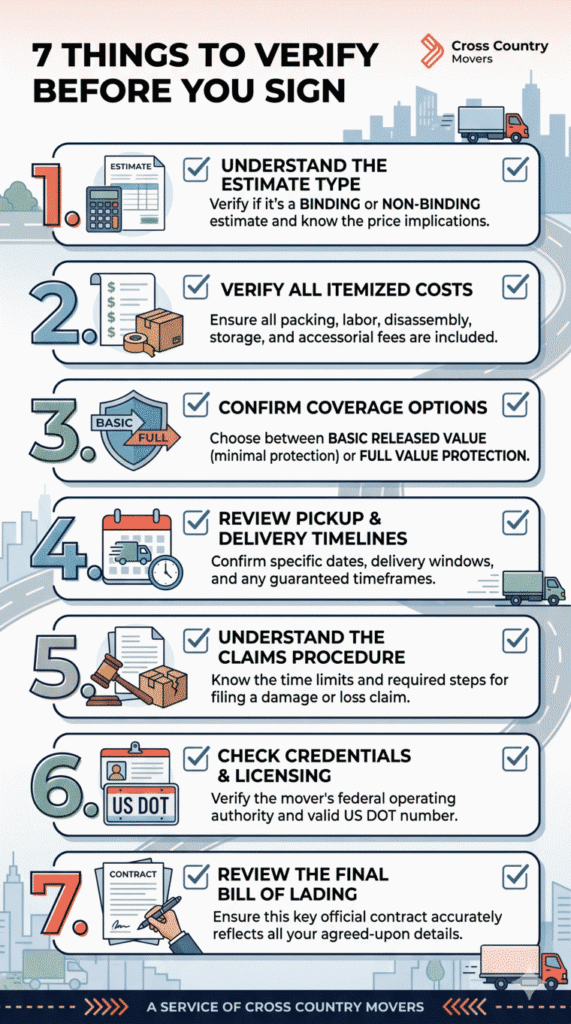
Top Long-Distance Movers at a Glance (2026)
A quick-reference ranking by overall fit for a typical full-household interstate move. Use it as a starting point, then run whichever option you choose through the checklist below.
1Cross Country MoversBest overall (full-service movers, direct carrier)
crosscountrymovers.com
Direct carrierFlat-rate guaranteedUSDOT 25522604.75 / 5.0150+ countriesTemperature-controlled storage
A fully licensed direct carrier (USDOT 2552260, MC-889368), not a broker, so one trusted team handles packing, loading and unloading, and delivery. What stands out:
- Guaranteed flat price based on a detailed inventory list with no surprise fees or weight-based charges
- Experienced movers trained to handle fragile and bulky items with care and attention to detail
- Comprehensive services including packing, storage in temperature-controlled facilities, and car shipping
- Full-service international moving to over 150 countries including packing and customs documentation
- Timely pick-up and drop-off respecting clients' schedules for all moves, local or cross-country
Published rating: 4.75 out of 5.0. See how it ranks among LA movers.
2National van line networksBest for very large households
Household-name carriers with broad reach, though your move may pass between separate local agents, which can blur accountability.
3Moving container servicesBest for flexible timelines
You load a container and the company drives it. Watch the container rental fees, and remember the packing and loading quality is on you.
4Freight and self-service shippingBest for small or budget moves
You pay for the trailer space you use, which keeps transportation costs low for studios and one-bedroom loads packed tightly.
5Specialty and white-glove moversBest for high-value items
Focused on pianos, fine art, and antiques with custom crating and climate control, usually with premium additional services.
The same checklist applies wherever you are moving, whether between major metros like Los Angeles, San Francisco, San Jose, Detroit, Austin, Texas, or Mesa, Arizona, or smaller cities like Traverse City or Lansing, Michigan.
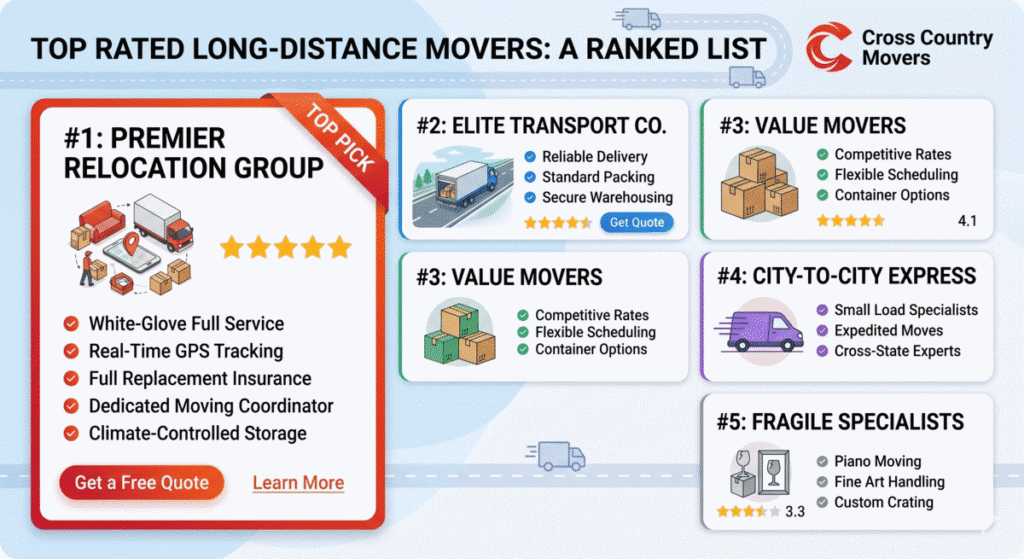
The 8 Key Things to Look For When Hiring
Use this as your checklist before requesting a single moving estimate.
1. FMCSA Licensing and a Valid USDOT Number
Any moving company that crosses state lines must be registered with the Federal Motor Carrier Safety Administration (FMCSA) and carry a USDOT number.
Verify it yourself at protectyourmove.gov to confirm active authority and review complaint history. A carrier that cannot produce a USDOT number on request should be ruled out immediately.
2. Carrier vs. Broker
A direct carrier transports your shipment with its own crews and trucks. A broker sells your job to a separate carrier and does not handle the move itself.
Brokers are legal and must also be registered, but a direct carrier keeps one team accountable end to end. It is also fair to ask whether the company runs background checks on its crews.
3. A Written Binding Estimate
Always get the price in writing, based on an on-site estimate or a virtual survey of your belongings.
A binding estimate locks in your total. With a non-binding estimate, federal law caps what the mover can collect at delivery at 110 percent of the quote, known as the 110 percent rule. A number guessed over the phone is not a real moving estimate, so gather at least three written moving company quotes to compare.
4. Insurance and Valuation Coverage
This is where many people get caught off guard. Released-value protection is the free default, and it pays only 60 cents per pound per item, which is almost nothing for electronics or antiques.
Full value protection, sometimes called full replacement value insurance, makes the mover liable to repair or replace lost or damaged items. Ask exactly what the insurance includes, what an upgrade costs, and how the claims process works, then confirm it in writing.
5. Transparent Pricing and No Hidden Fees
The best companies quote a guaranteed flat price based on a detailed inventory list, with no hidden fees or surprise weight-based charges.
Ask how fuel costs, mileage fees, truck size, long-carry and stair fees, and storage-in-transit factor into your transportation costs. A reputable mover discloses all of these upfront.
6. The Range of Services Offered
Strong long-distance movers do more than drive a truck. Look for full-service movers that handle packing services and packing supplies, loading and unloading, furniture assembly/disassembly, custom crating, vehicle shipping, and self storage, ideally coordinated under one quote rather than farmed out.
If you need international moving or other additional services, confirm that experience directly.
7. Reputation, Reviews, and Accreditation
Check Google, the Better Business Bureau, and the FMCSA complaint database, and look for patterns in customer reviews rather than a single star rating.
Professional accreditation and how a company responds to negative reviews often tell you more than the praise does.
8. Experience, Customer Service, and Communication
Favor professional movers with several years of experience and a clear track record on routes like yours.
Responsive customer service, a single point of contact or move coordinator, and digital tools such as online shipment tracking all make a long-distance move far less stressful.
Questions to Ask Before You Sign
- Are you a direct carrier or a broker, and what is your USDOT number?
- Is this a binding estimate or a non-binding estimate, and is it in writing?
- What does my valuation coverage pay, and what does full value protection cost?
- Do your own crews handle the loading and unloading, or do you use subcontractors?
- What is the delivery window, and what is your claims process if something is damaged?
- Are packing services, supplies, storage, and vehicle shipping included in this quote, or billed separately?
- Are there any additional services or fees not listed here?
A mover who hesitates or deflects on any of these is a red flag.
Plan Your Moving Timeline
Build a realistic moving timeline and a moving checklist as soon as you have a target moving date.
Confirm pickup and delivery windows in writing, ask whether your buildings require moving permits or elevator reservations, and keep a copy of your inventory list for any future claims.
Red Flags to Walk Away From (and How to Spot Moving Scams)
Most moving scams and moving fraud share the same warning signs:
- No USDOT number, or refusal to provide one.
- A large deposit demanded upfront, especially in cash.
- An estimate given without any survey of your belongings.
- A quote that is dramatically lower than every other bid.
- No written contract, or a request to sign a blank or incomplete document.
What a Cross-Country Move Costs in 2026 (Quick Context)
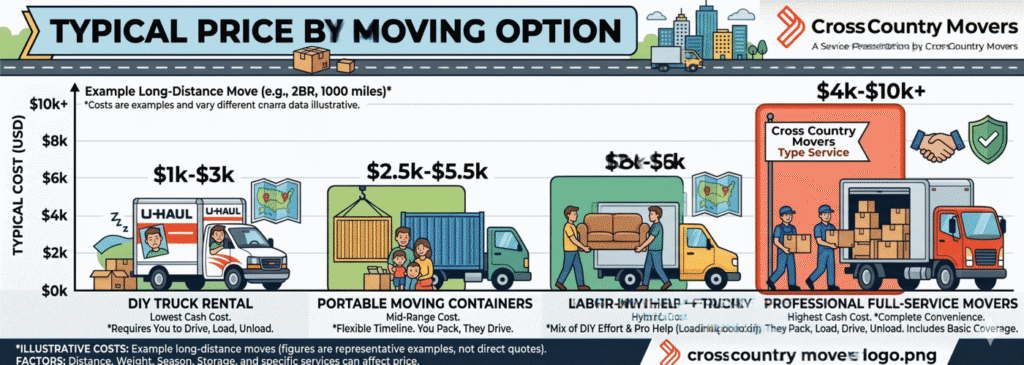
Pricing helps you sanity-check a quote. For a typical 2 to 3 bedroom household:
← swipe to see all columns →
| Option | Typical Cross-Country Price | Notes |
|---|---|---|
| Full-service movers | $3,500 to $6,500 (up to $9,000+ for large or white-glove) | Most protection, least effort |
| Moving container | roughly $3,000 to $5,000 | You pack and load; watch container rental fees |
| Freight / self-service | $2,000 to $4,500 | Best for small loads |
| Rental truck (DIY) | $1,500 to $3,500 | Cheapest, most work; factor in truck size and mileage fees |
Prices rose in 2026, with industry data pointing to a roughly 20 percent increase driven largely by fuel costs, and the steepest jumps on the West Coast. Always get at least three written moving company quotes before committing.
Hiring Movers in the Los Angeles Area? A Quick Note
If you are moving out of the LA area, vet for local experience too. Freeway timing, building access, moving permits, and Certificates of Insurance for high-rises all matter here.
Neighborhoods and cities like Santa Monica, Pasadena, Sherman Oaks, Silver Lake, and Long Beach each have their own parking and permit quirks that an experienced crew will plan around.
For a local comparison, see our guide to the best cross country movers in Los Angeles, California. And if you are moving to or from the state, our overview of trusted California movers walks through packing, storage, and vehicle shipping options.
The Bottom Line
When hiring a long-distance moving company, licensing comes first, the written binding estimate comes second, and insurance and valuation coverage come third. Everything else, services, customer reviews, and communication, helps you choose between the legitimate carriers that clear those three bars.
Run every candidate through the checklist, ask the questions, compare quotes, and walk away from the red flags. Do that, and the rest of your move gets a lot easier.
This guide is reviewed and updated regularly to reflect current pricing trends and federal regulations. Always verify a mover's FMCSA authority independently before booking.
Frequently Asked Questions
- How do I verify a moving company is licensed?
Ask for the company's USDOT number and search it in the FMCSA database at protectyourmove.gov. You can confirm active authority, insurance, and complaint history there. Cross-check with the Better Business Bureau and Google customer reviews. A licensed carrier will share these details without hesitation.
- Should I hire a direct carrier or a broker?
For most long-distance moves, a direct carrier is the safer choice because one team is accountable from pickup to delivery. A broker sells your job to another moving company, which can add uncertainty about who actually shows up. Both must be FMCSA-registered, so always confirm which one you are dealing with.
- What is the difference between a binding and non-binding estimate?
A binding estimate locks in your total price. A non-binding estimate can change based on actual weight and services, but under the federal 110 percent rule the mover cannot require more than 110 percent of the quote at delivery. Always get the moving estimate in writing.
- How far in advance should I book a long-distance mover?
Book six to eight weeks ahead for a peak-season moving date (May through August). Three to four weeks is usually enough off-season. Booking early gives you more choice of dates, time to compare quotes, and room to build your moving timeline.