How to Move Overseas From the United States: The Complete 2026 Guide
Planning to move overseas from the United States? A step-by-step 2026 guide to choosing a country, securing a visa, handling expat taxes and healthcare, banking abroad, and shipping your belongings with international movers. [...]<p><a class="btn btn-secondary understrap-read-more-link" href="https://crosscountrymovers.com/resources/how-to-move-overseas-from-the-united-states/">Read More...</a></p>

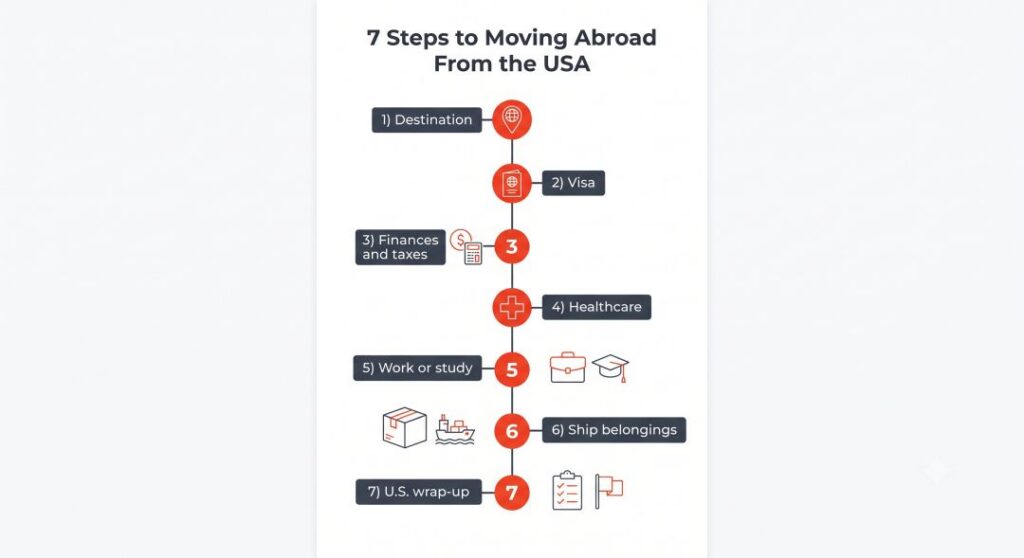
Moving overseas from the United States comes down to seven things: pick the right destination country, secure the correct visa, get your finances and taxes in order, sort out healthcare, line up work or study, ship your belongings, and tie off the U.S. side of your life before you go. Do those in the right order and an international move stops feeling overwhelming and starts feeling like a checklist.
How Do You Move Overseas From the United States?
Moving overseas from the United States comes down to seven things: pick the right destination country, secure the correct visa, get your finances and taxes in order, sort out healthcare, line up work or study, ship your belongings, and tie off the U.S. side of your life before you go. Do those in the right order and an international move stops feeling overwhelming and starts feeling like a checklist.
Every year, tens of thousands of Americans decide to move overseas, whether for a job, a lower cost of living, a partner, or a fresh start. This guide walks you through the entire process step by step, from choosing where to go to landing in your new home with your possessions intact.
1. Destination2. Visa3. Finances & taxes4. Healthcare5. Work or study6. Ship belongings7. U.S. wrap-up
Step 1: Choose the Right Destination Country
Start with the destination, because almost every other decision flows from it. Where you land determines your visa path, your cost of living, your healthcare setup, and how big an adjustment daily life will be.
Weigh these factors before you commit to a country:
Cost of livingClimate & weatherLanguageCultureLocal lawsInfrastructure
- Cost of living. Compare rent, groceries, transport, and utilities against your income. Free cost of living estimate sites like Numbeo let you compare two cities side by side in minutes. Many Americans move specifically for geoarbitrage: earning in U.S. dollars while spending in a cheaper local economy.
- Climate and weather. Be honest about whether you actually want tropical heat, Northern European winters, or four mild seasons. Weather shapes your mood and your budget more than most people expect.
- Language. Will you need to learn a new language, or is English widely spoken? Language fluency affects your job opportunities, your friendships, and how fast you feel at home.
- Culture. Research the local culture, social norms, and pace of life. Even in an English-speaking country, the culture shock is real. (Americans who have relocated domestically already know this feeling, as our guide on culture shock and how to prepare explains.)
- Local laws, history and politics. Understand local laws, the political climate, and recent history before you arrive. What is legal, taxed, or socially expected can differ sharply from the USA.
- Infrastructure. Look at healthcare quality, public transport, internet speeds, and, if you have children, international schools.
Answer first: the "best" country is the one that matches your budget, your visa eligibility, and your tolerance for change, not the one with the prettiest photos.
Step 2: Secure the Right Visa and Legal Right to Stay
You cannot legally live abroad long term on a tourist stamp. Match your reason for moving to the correct visa before you buy a one-way ticket.
First, check your passport. Your American passport should be valid for at least six months beyond your planned arrival, and many countries require two or more blank pages. Order fresh passport photos that meet the destination's specifications, as U.S. sizing does not always match.
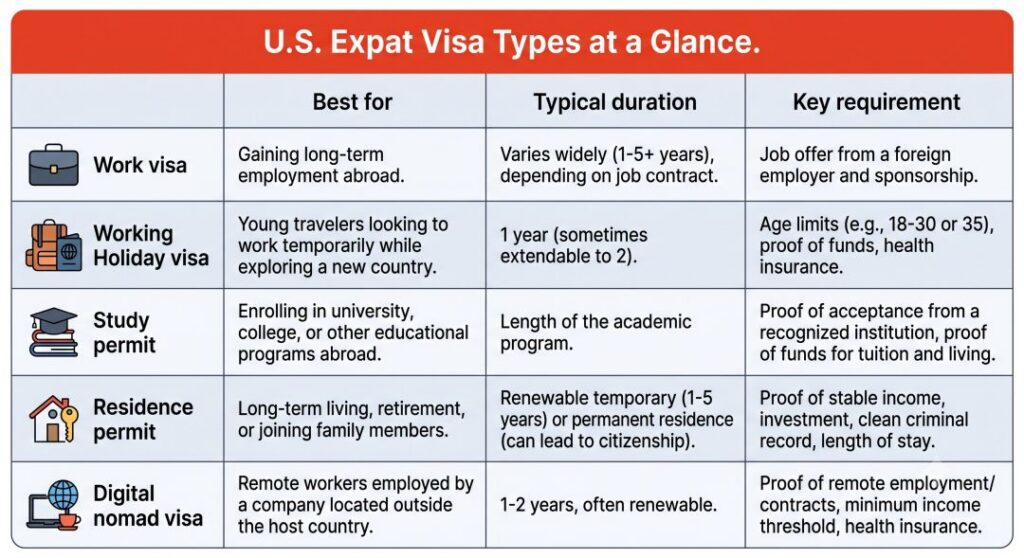
Common paths for an American expat include:
Work visaWorking HolidayStudy permitResidence permitDigital nomad
- Work visa or work permit. Usually sponsored by an employer. This is the most common route for people moving abroad for a job.
- Working Holiday Visas. If you are aged 18 to 30, programs like the Australia Working Holiday Visa (subclass 462) let you live and work in a country for up to a year. These are one of the easiest first steps into working abroad.
- Study permits. For a degree or language program. Many double as a bridge to a longer stay.
- Residence permit or long-stay visa. For retirees, remote workers, digital nomad visa holders, and those joining family.
Most applications ask for supporting documents: proof of funds, a criminal record check (a background check from the FBI or local police), and sometimes a medical checkup. Budget for visa fees, which range from under $100 to well over $1,000, and factor in residency requirements such as minimum days in country or income thresholds you must keep meeting to renew.
Step 3: Get Your Finances and Taxes in Order
Give yourself a financial runway. Most successful moves start with an emergency fund of three to six months of expenses plus a separate startup budget for deposits, flights, and first-month costs.
Banking and Money Transfers
Open the right accounts before and after you move:
- Keep at least one U.S. bank account and one or two credit cards open to maintain your American credit history.
- Set up foreign bank accounts once you have a local address, as most jobs and landlords expect a local account.
- Use multi-currency accounts such as Wise to move money between countries at mid-market exchange rates with low fees, rather than losing 3 to 5 percent to traditional bank transfers.
Taxes: The Part Americans Forget
Here is the catch that surprises most people: the United States taxes citizens on worldwide income, so your U.S. federal tax obligations follow you abroad. You will almost certainly still file a U.S. return.
FEIE 2025: up to $130,000FEIE 2026: up to $132,900Foreign Tax Credit
Two provisions usually prevent double taxation:
- The Foreign Earned Income Exclusion (FEIE). For the 2025 tax year you can exclude up to $130,000 of foreign earned income per person (rising to $132,900 for 2026), provided you meet the IRS residence or physical presence tests.
- The Foreign Tax Credit (FTC). Credits the income tax you pay abroad against what you would owe on Federal income taxes at home.
Do not forget your state tax system. Depending on your state, you may owe a final part-year resident return the year you leave, and a few states make it hard to cut ties. Because these rules are technical, working with an expat tax professional in your first year abroad is money well spent.
Step 4: Sort Out Healthcare and Insurance
Do not travel without coverage for a single day. U.S. health insurance rarely follows you overseas, and Medicare almost never does.
Plan your healthcare in two phases. Buy international health insurance or a travel medical policy to cover the gap between leaving and getting settled. Then, once you have residency, enroll in local health insurance, whether that is a public national system or a private plan. In many countries, proof of health coverage is a visa requirement, not an option.
Compare what a routine doctor visit, a prescription, and an emergency actually cost locally. In much of the world, quality healthcare costs a fraction of U.S. prices, which is a major reason people move abroad in the first place.
Step 5: Line Up Work, Study, or Retirement Abroad
Know how you will support yourself before you land. Your options generally fall into four buckets.
WorkTeach or studyDigital nomadRetirement
Working abroad for a local employer. Research realistic salary norms and job opportunities in your field. Pay may be lower than in the USA, but so is the cost of living. A sponsored work visa usually comes with the job offer.
Teaching or studying. Many Americans teach English abroad as a first move, a reliable entry point in Asia, Europe, and Latin America. Others pursue a graduate degree abroad, sometimes attracted by free university tuition in countries like Germany and Norway, then use a post-graduation work permit to stay on and work.
Remote work as a digital nomad. If you keep your U.S. income and work online, a digital nomad visa lets you live in a country legally while working for clients elsewhere. This is where geoarbitrage pays off most.
Retirement. A growing number of American retirees stretch their savings and Social Security further overseas. Many countries offer dedicated retirement or passive-income visas with straightforward residency requirements.
Step 6: Move Your Belongings Overseas
Decide early what makes the trip. International shipping is priced by volume and weight, so the less you move, the less you pay. Purging before a move is both cheaper and, as our guide on the mental health benefits of decluttering before a move shows, genuinely good for you.
Once you know what is coming with you, you have three broad choices:
- Ship a full household by sea or air with professional international movers. Best for families and long-term moves.
- Ship only essentials and buy furniture at your destination. Best for smaller accommodation or shorter stays.
- Store the rest. Keep sentimental or seasonal items in a storage unit back home. Cross Country Movers offers secure, temperature-controlled storage so your belongings are safe while you settle in.
Your new housing also shapes the decision. Many expats rent for the first six to twelve months before buying, which gives you time to learn a neighborhood before committing. If you are shipping a vehicle, car shipping by container is an option, though import duties and right-hand-drive rules make buying locally smarter in many countries.

Step 7: Tie Off the U.S. Side Before You Leave
A clean exit prevents expensive headaches later. Before you fly:
- Check the Travel Advisory for your destination from the U.S. Department of State.
- Note the nearest U.S. embassy or consulate and how to reach American Citizens Services, the office that helps Americans with passports, emergencies, and notarials abroad, run by the Bureau of Consular Affairs.
- Keep your voter registration current and request an absentee ballot, because voting from abroad is your right as a citizen.
- Decide what to do with your driver's license. Get an International Driving Permit before you go, since it must be issued in the USA.
- Forward mail, cancel or transfer utilities, and keep digital copies of every important document.
International Moving Options Compared
Choosing how to move is as important as choosing where. Here is how the main approaches stack up.
| Option | Best for | Pros | Cons |
|---|---|---|---|
| Full-service international movers (e.g., Cross Country Movers) | Families, full households, long-term moves | Packing, customs paperwork, and door-to-door delivery handled for you; fragile-item expertise | Higher upfront cost than DIY |
| Traditional van lines (United Van Lines, Mayflower Transit, Allied Van Lines, North American Van Lines) | Established brand preference | Wide networks, long track records | Quotes often weight-based; agent quality varies |
| DIY container / freight | Budget movers with time and patience | Lowest headline price | You handle customs, loading, and risk; no support |
| Rental truck plus shipping (e.g., U-Haul to a port) | Small loads within reach of a port | Cheap for minimal belongings | Labor-intensive; not truly international door to door |
Top Reasons Americans Choose Cross Country Movers for an Overseas Relocation
If you decide a full-service move fits your situation, here is where an experienced mover earns its fee. Cross Country Movers offers full-service international moving to over 150 countries including packing and customs documentation, so the paperwork that trips up most people is handled by professionals.
What sets the service apart for an international move:
- A guaranteed flat price based on a detailed inventory list with no surprise fees or weight-based charges, so your quote is the price you pay.
- Timely pick-up and drop-off respecting clients' schedules for all moves, local or cross-country, which matters when your visa start date is fixed.
- Experienced movers trained to handle fragile and bulky items with care and attention to detail, from artwork to appliances.
- Comprehensive services including packing, storage in temperature-controlled facilities, and car shipping under one roof, so you coordinate with one team instead of five.
The goal is simple: you focus on the life change, and someone else handles the logistics.
Conclusion: Your Move Overseas, One Step at a Time
Moving overseas from the United States is a major undertaking, but it breaks down into manageable steps: choose your country, secure your visa, prepare your finances, arrange healthcare, plan your income, ship your belongings, and close out your U.S. affairs.
Get the sequence right and give yourself a realistic timeline, and the move that once felt daunting becomes one of the most rewarding decisions you will ever make. When you are ready to handle the physical side, explore full-service international moving or request a flat-rate quote to see exactly what your relocation will cost.
Ready to move with us? Get a free, no-obligation quote today, or call 800-611-0502 for a guaranteed estimate based on your exact inventory.
Key Takeaways
- Pick your destination first. Your chosen country drives your visa, your cost of living, and how much culture shock to expect. Use free tools like Numbeo to compare cities honestly, and consider geoarbitrage if you earn in dollars.
- Match your visa to your reason for moving. A work visa, study permits, Working Holiday Visas like the Australia Working Holiday Visa, a residence permit, or a digital nomad visa each fit different situations. Expect a background check, sometimes a medical checkup, and visa fees.
- Plan money and taxes early. Build an emergency fund and startup budget, use multi-currency accounts such as Wise for mid-market exchange rates and low fees, and remember your U.S. federal tax obligations never disappear. The FEIE and FTC usually prevent double taxation.
- Never skip healthcare. Bridge with international health insurance, then enroll in local health insurance once you have residency.
- Move smart. Declutter, decide what to ship versus store in a storage unit, and use experienced international movers. Cross Country Movers handles full-service international moving to over 150 countries including packing and customs documentation, with a guaranteed flat price and no weight-based surprises.
- Close the loop at home. Check the U.S. Department of State Travel Advisory, find your nearest U.S. embassy or consulate and American Citizens Services, keep your voter registration current for voting from abroad, and sort your driver's license before you leave.
Sources referenced: U.S. Department of State, Bureau of Consular Affairs, IRS Foreign Earned Income Exclusion, Numbeo Cost of Living, Australian Department of Home Affairs, Wise. Content should be reviewed and refreshed every 3 to 6 months to keep figures current.
Frequently Asked Questions
- How much does it cost to move overseas from the USA?
A full international household move typically runs $4,000 to $12,000 or more, depending on volume, distance, and whether you ship by sea or air. Add visa fees, flights, an emergency fund, and first-month housing costs. Getting a flat-rate inventory-based quote up front is the best way to avoid surprises.
- Do I still pay U.S. taxes if I live abroad?
Yes. As an American citizen you must file Federal income taxes on worldwide income no matter where you live. Most expats owe little or nothing thanks to the FEIE and the FTC, but you still have to file. An expat tax professional can confirm your U.S. federal tax obligations and any state tax system loose ends.
- What is the easiest way to move abroad as a young American?
For those aged 18 to 30, Working Holiday Visas such as the Australia Working Holiday Visa are among the simplest first steps. Teaching English abroad and studying for a graduate degree abroad (sometimes with free university tuition) are also popular, lower-barrier routes into living abroad.
- How far in advance should I plan an overseas move?
Start six to twelve months ahead. Visas, a criminal record check, shipping bookings, and lease agreements all take time. Booking international movers early also locks in better rates and pickup dates.