Cross Country Movers in Boston, Massachusetts: The Complete 2026 Guide to a Long-Distance Move From The Hub
Planning an interstate move to or from Boston? Learn what cross country movers in Boston cost in 2026, how street permits and September 1 leases work, and how to choose a licensed long-distance moving company. [...]<p><a class="btn btn-secondary understrap-read-more-link" href="https://crosscountrymovers.com/resources/cross-country-movers-boston-massachusetts-guide/">Read More...</a></p>
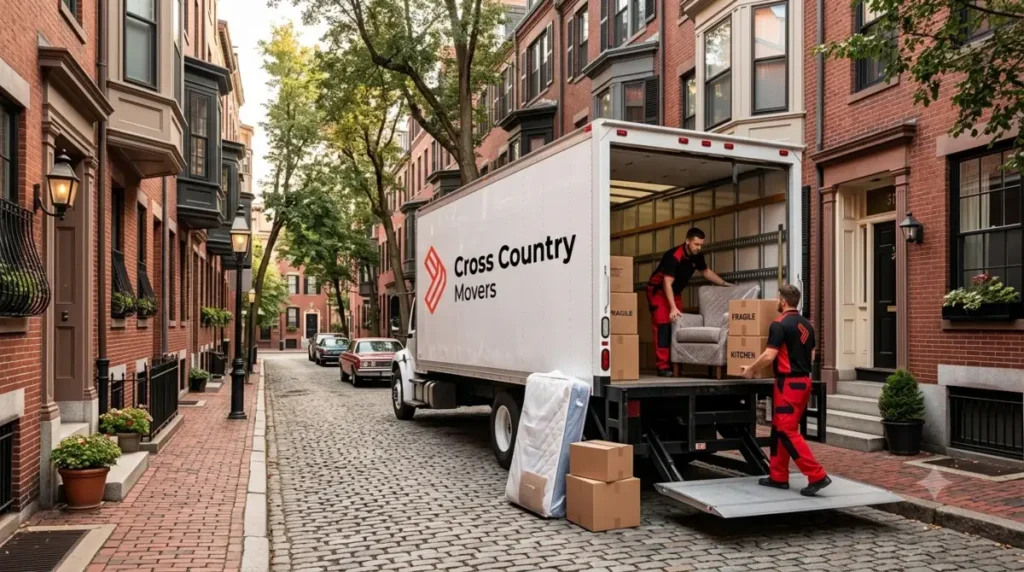
A cross-country move from Boston is an interstate move, usually 1,000 miles or more, priced on your inventory and distance rather than by the hour. That single distinction shapes everything else about long-distance moving out of Massachusetts.
What Makes a Cross Country Move From Boston Different?
A cross-country move from Boston is an interstate move, usually 1,000 miles or more, priced on your inventory and distance rather than by the hour. That single distinction shapes everything else about long-distance moving out of Massachusetts.
It is only half the story, though. Boston adds a layer of local logistics that most American cities do not have. Colonial-era streets in the North End and Beacon Hill were never designed for a 26-foot moving truck. Triple-decker walk-ups in Dorchester, South Boston, and Jamaica Plain mean a stair carry is the norm, not the exception. And because so many leases in the city turn over on September 1, late August and early September are the most competitive booking window of the year.
The takeaway: in Boston, the mover you choose matters as much as the date you choose. Experienced cross country movers serving Boston plan around permits, parking, and building access before the truck ever arrives.
How Much Do Cross Country Movers in Boston Cost in 2026?
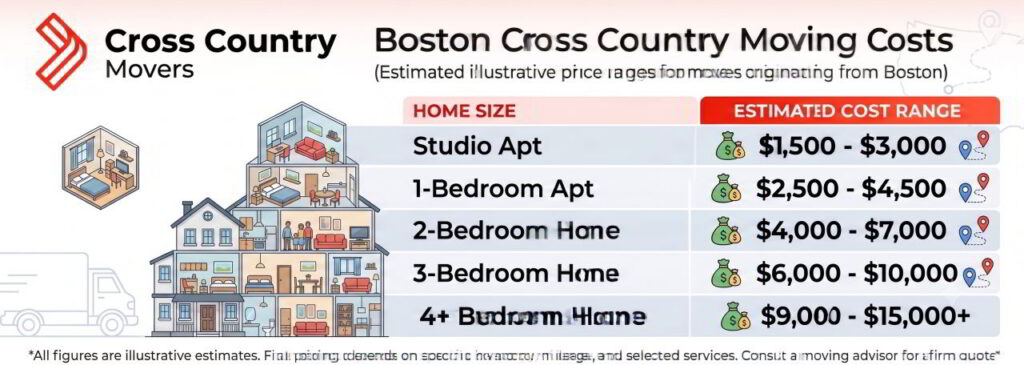
Most long-distance moves from Boston land between $2,800 and $7,500, depending on destination and home size. Boston to California, the longest common route, averages $4,500 to $7,000 for a typical household.
$2,800 to $7,500 typical rangeBoston to CA: $4,500 to $7,000Inventory-based pricingFlat-rate quotes
Three factors drive the final number:
- Inventory size. A studio in Allston ships for far less than a four-bedroom in West Roxbury. The item list, not the square footage, is what movers actually price.
- Distance and route planning. Boston to Florida, Texas, or the West Coast costs more than Boston to the Mid-Atlantic simply because of mileage and transit time.
- Services added. Full packing, custom crating for a piano or artwork, auto transport, and storage each add to the base transportation price.
Timing matters too. Peak season, roughly May through September, brings the highest demand and the firmest prices, while an off-peak season move in fall or winter usually means better availability and more scheduling flexibility.
Binding vs. Non-Binding Estimates: Know What You Are Signing
A moving estimate comes in two basic forms. A binding estimate fixes the price for the listed inventory, while a non-binding estimate is only a projection: if your shipment weighs more than guessed, the final bill grows with it.
That is why inventory list pricing is the model worth insisting on. In plain terms: a guaranteed flat price based on a detailed inventory list with no surprise fees or weight-based charges. Weight-based charges can shift after your belongings are already on the truck, while an inventory-based flat price locks the number before moving day. Cross Country Movers builds Boston quotes this way, and the inventory list can be updated until one day before the move.
Two more money questions to ask upfront: whether an estimate deposit is required to reserve your date, and exactly what it covers. For a wider look at fees that catch people off guard, from elevator fees to last-minute supply runs, see this breakdown of hidden moving costs and how to avoid them.
Boston-Specific Logistics: Permits, Parking, and September 1
Short answer: yes, your moving truck almost certainly needs a permit. The City of Boston requires a street occupancy permit, essentially a temporary parking permit for your truck, to reserve curb space in most neighborhoods, and signs must be posted in advance so the space is actually clear on moving day.
Handled late or not at all, a missing permit can mean circling the block, a long carry from wherever the truck finally parks, or a rescheduled move. Reputable Boston crews coordinate street permits when needed and treat a stair carry in walk-ups as part of the job rather than an add-on.
Why September 1 Matters
Boston runs on an academic calendar. With dozens of colleges and universities in the metro area, including Harvard and MIT, an enormous share of leases begin September 1. That single date concentrates demand for trucks, elevators, and curb space.
If your move is flexible, booking outside the late-August rush usually means calmer streets and better crews. If it is not, book as early as you possibly can.
Neighborhood Access Realities
- North End and Beacon Hill: narrow one-way streets and tight corners often call for a shuttle service, where a smaller truck ferries your belongings between your door and the full-size trailer, plus careful permit planning.
- South Boston, Dorchester, Jamaica Plain, and Allston-Brighton: triple-decker walk-ups make stair experience essential.
- Back Bay and South End: resident permit parking is strictly enforced, so reserved curb space is non-negotiable.
- Downtown high-rises and buildings near Logan Airport corridors in East Boston: many properties require an elevator reservation and a certificate of insurance (COI) from the mover before crews are allowed in.
Core Services to Look For in a Boston Long-Distance Mover
The best full-service moving packages bundle the whole relocation, not just the drive. Here is what to look for and how each piece works in practice.
Professional Packing and Custom Crating
Packing is where most damage risk lives, especially on a 3,000-mile route. Strong packing services cover partial packing for a few fragile items or full packing for the entire household, with the crew bringing the right packing materials for everything on your list, plus custom crating for pianos, artwork, and gym equipment.
What separates a great crew from an average one is training: experienced movers trained to handle fragile and bulky items with care and attention to detail. With Cross Country Movers, standard disassembly, packing, and reassembly of furniture, technology, and appliances is included at no charge, and dedicated professional packing services cover everything beyond that.
Auto Transport
Driving your own car from Boston to Denver or Los Angeles adds days, fuel, hotels, and winter-weather risk. Shipping it alongside your household is often the more affordable and less stressful path.
Two options exist: open transport, the industry-standard and budget-friendly choice, and enclosed transport for luxury, classic, or low-profile vehicles. Both door-to-door and terminal-to-terminal delivery are available through a dedicated car shipping service, and combining vehicle and household shipments can earn a discount.
Storage Between Homes
Closing dates slip. Renovations run long. September 1 leases do not always line up with the day you have to vacate. Storage-in-transit bridges that gap, and the best setups use temperature-controlled storage rather than bare warehouse space.
Cross Country Movers includes 30 days of storage free with a move, in private temperature-controlled units. If you are not sure whether you will need it, this guide to when you actually need storage during a move walks through five real-life scenarios.
Valuation Coverage, Insurance, and the Claims Process
Federal law requires interstate movers to offer valuation coverage, which is not the same thing as insurance but serves a similar protective role. You will typically choose between:
- Released value protection: the mandatory baseline, paying 60 cents per pound per damaged item.
- Full-value protection: an added service that repairs, replaces, or reimburses items at their actual worth.
- Third-party insurance: supplemental coverage for high-value households.
Vehicles get their own coverage in transit, up to $100,000 on an open carrier and $500,000 on an enclosed one with Cross Country Movers.
One document ties all of this together: the Bill of Lading. It is the contract for your shipment, and it governs the claims process if anything is damaged, so read it before pickup, not after delivery.
One Company, Door to Door
Broader scope matters too. Comprehensive services including packing, storage in temperature-controlled facilities, and car shipping handled by a single carrier mean one point of accountability instead of three vendors pointing at each other. And for households leaving the US entirely, full-service international moving to over 150 countries including packing and customs documentation keeps even an overseas move under one roof.
How to Choose Cross Country Movers in Boston: A 7-Point Checklist
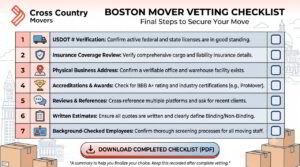 Choosing an interstate moving company is mostly about verification, not vibes. Run every candidate through this list:
- FMCSA registration. Every legitimate interstate mover holds a USDOT number issued by the FMCSA. Confirm the USDOT and MC numbers free at protectyourmove.gov. Cross Country Movers operates under USDOT 2552260 and MC-889368.
- Direct carrier vs. moving broker. A direct carrier owns the trucks and employs the crews. A moving broker sells your move to whoever bids. National van lines fall somewhere in between, fulfilling moves through an agent network of local affiliates, which means quality can vary by location.
- Binding, inventory-based pricing. Get the flat rate in writing, ask whether an estimate deposit is required, and confirm what happens if your inventory changes.
- An honest inventory walkthrough. A serious mover builds your quote from a room-by-room inventory walkthrough, virtual or in person, rather than a guess over the phone.
- Boston experience. Ask specifically about street permits, walk-up buildings, shuttle service on narrow streets, and September 1 scheduling.
- Reviews across platforms. Read recent reviews on multiple independent platforms, not just the testimonials a company curates.
- Timing commitments. Timely pick-up and drop-off respecting clients' schedules for all moves, local or cross-country should be stated policy, not a hope. Pin down the pickup window and delivery window in writing before you sign.
Comparing Your Options: Full-Service Mover vs. Container vs. DIY
| Option | Best for | Typical Boston trade-offs |
|---|---|---|
| Full-service direct carrier | Full households, tight timelines, walk-ups | Highest convenience and accountability; costs more than DIY moving but includes labor, permit help, and protection options |
| Portable container plus labor-only movers | Flexible timelines, smaller loads | You pack yourself and hire loading help separately; container placement on Boston streets can require the same permits with no full-service crew to manage them |
| DIY rental truck | Studios, minimal budgets | Cheapest on paper, but add fuel, tolls, hotels, insurance, and driving a large truck through New England traffic and winter weather |
For most families moving 1,000-plus miles out of Boston, the full-service option costs more upfront and less in risk, time, and stress.
Before the Truck Arrives: Declutter and Build Your Checklists
The cheapest item to move is the one you do not move. Declutter room by room four to six weeks out, since inventory list pricing means every donated bookcase directly lowers your quote.
Then work from two documents: a moving checklist that tracks tasks by week (permits, utilities, address changes, school records) and an inventory checklist that mirrors the list your mover priced, so you can verify every box and every piece of furniture at delivery.
Conclusion: Moving Out of The Hub the Smart Way

Boston rewards planners. Verify FMCSA registration, insist on a flat inventory-based price, sort the street permit early, and steer around September 1 if you can. Do those four things and a long-distance move from one of America's oldest cities becomes a logistics exercise instead of an ordeal.
When you are ready to compare quotes, start with the Boston page from Cross Country Movers or call 800-611-0502 for a free, guaranteed estimate based on your exact inventory.
Key Takeaways
- A cross-country move from Boston typically costs $2,800 to $7,500 depending on home size and destination, with Boston to California averaging $4,500 to $7,000.
- Boston is one of the trickiest US cities to load a truck in: narrow streets, walk-up apartments, resident-only parking, and the September 1 lease turnover all affect planning.
- Moving trucks in most Boston neighborhoods need a street occupancy permit from the city, so book a mover that coordinates permits for you.
- Any company handling an interstate move must be registered with the FMCSA and carry a USDOT number. Verify it free at protectyourmove.gov before signing.
- Insist on a binding, inventory-based flat price rather than a non-binding estimate, and get your pickup window and delivery window in writing.
Frequently Asked Questions
- How much do cross country movers from Boston charge?
Cross country moves from Boston typically cost $2,800 to $7,500 depending on destination and home size, with Boston to California averaging $4,500 to $7,000. Flat-rate, inventory-based quotes lock the price before moving day.
- Do I need a permit for a moving truck in Boston?
In most neighborhoods, yes. The City of Boston requires a street occupancy permit to reserve curb space for a moving truck, with signs posted in advance. Experienced Boston movers coordinate the permit for you.
- Can movers handle Boston's narrow streets and walk-up apartments?
Yes, if they are experienced in the city. Crews familiar with Boston plan for narrow streets, limited parking, and triple-decker walk-ups, and quality flat-rate quotes include stair carries at no extra charge.
- When is the best time to book a cross country move from Boston?
Book four to eight weeks ahead for most of the year, and even earlier for late August and early September, when the citywide lease turnover makes trucks and crews scarce. Off-peak months typically offer better availability.