How Much Does It Cost to Transport a Vehicle When Moving Cross Country?
What it costs to transport a vehicle when moving cross country: 2026 per-mile rates, open vs enclosed pricing, fuel surcharges, and the drive-vs-ship math. [...]<p><a class="btn btn-secondary understrap-read-more-link" href="https://crosscountrymovers.com/resources/how-much-does-it-cost-to-transport-a-vehicle-when-moving-cross-country/">Read More...</a></p>
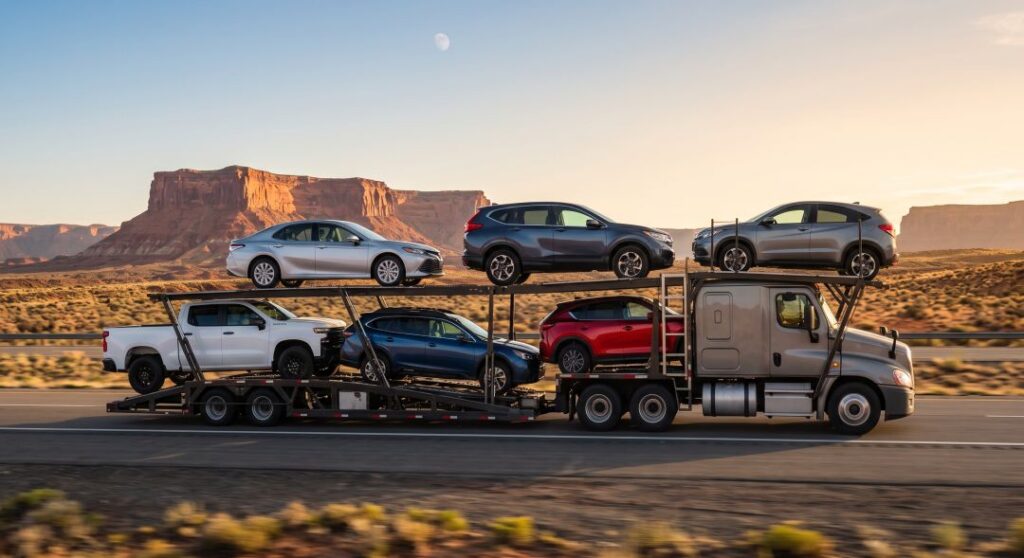
Most people moving cross country pay $1,200 to $1,900 to ship one operable sedan on an open carrier. An SUV or pickup truck runs $150 to $400 higher. Enclosed transport adds 30% to 60% on top of whatever the open rate is.
If you want a single number to drop into a spreadsheet right now, use $1,500 per vehicle and adjust from there.
Here is the part most cost guides skip. When you are moving, car transport is not a standalone purchase. It is one line in a much bigger budget, and the decisions you make about the rest of the move, timing, route, whether you bundle it with your household goods, will move the car number as much as the car itself does.
This guide covers what actually drives your car shipping cost in 2026, why fuel prices are hitting quotes harder this year than last, and whether driving it yourself is still cheaper. Spoiler on that last one: less often than people assume.
Quick Cost Reference by Distance
Per-mile rates fall as distance climbs. Short hops are the worst value in the industry. Cross-country is the best.
← swipe to see all columns →
| Distance | Typical per-mile rate | Open carrier total (sedan) | Enclosed total (sedan) |
|---|---|---|---|
| Under 500 miles | $1.40 to $2.20 | $400 to $750 | $550 to $1,150 |
| 500 to 1,000 miles | $1.00 to $1.50 | $650 to $1,050 | $900 to $1,600 |
| 1,000 to 1,500 miles | $0.80 to $1.20 | $850 to $1,300 | $1,150 to $2,000 |
| 1,500 to 2,000 miles | $0.60 to $0.90 | $1,000 to $1,500 | $1,400 to $2,300 |
| 2,000+ miles (coast to coast) | $0.45 to $0.70 | $1,200 to $1,900 | $1,700 to $2,900 |
These are 2026 market ranges for standard, operable vehicles. Your actual car shipping quote depends on the specific lane, the pickup date, and how much flexibility you have.
What Determines Your Car Transport Cost
Nine variables do most of the work. Understanding them is the difference between accepting a quote and negotiating one.
1. Distance and Route
Distance sets the floor. Route sets everything else.
A common carrier lane is a corridor haulers run constantly because freight flows both directions. Think I-95 down the East Coast, I-10 across the southern tier, I-40 through the middle, I-80 across the north. If both your pickup and delivery sit near major hubs on one of those, you are buying into an existing route and you pay less for it.
Get off those corridors and the math changes. A pickup in a rural area two hours from the nearest interstate means the driver burns time and fuel for one car. That shows up as a surcharge, or as a quote that quietly sits 20% above what your neighbor two towns over paid.
Terrain matters more than people expect. Routes crossing the Rockies or the Sierras cost more than flat-ground equivalents. Grade burns diesel and slows the truck, and both of those are the carrier's money.
2. Vehicle Size and Weight
Carriers sell trailer space and payload capacity, not affection for your car.
A sedan is the baseline. An SUV or minivan takes more deck and adds weight. A full-size pickup truck or a big cargo van takes the most. Ballpark it this way:
- Sedan: baseline
- Small SUV or compact van: add $100 to $200
- Full-size SUV or minivans: add $150 to $300
- Full-size pickup truck: add $200 to $400
- Lifted or modified vehicles: quote individually, sometimes much higher
Aftermarket lifts and oversized tires are worth mentioning up front. A truck that no longer fits the deck slot the carrier planned for is a problem discovered at loading, and problems discovered at loading are expensive.
3. Vehicle Condition
Quotes assume operable vehicles. If it starts, steers, brakes, and rolls, it loads under its own power.
Inoperable vehicles need winch loading, and not every carrier carries a winch. Expect $150 to $300 on top, plus a smaller pool of trucks that can take the job. That second part is the real cost. Fewer available carriers means less price competition on your lane.
If your car does not roll at all, say so when you request the quote. Discovering it at pickup means a rescheduled load and a revised price.
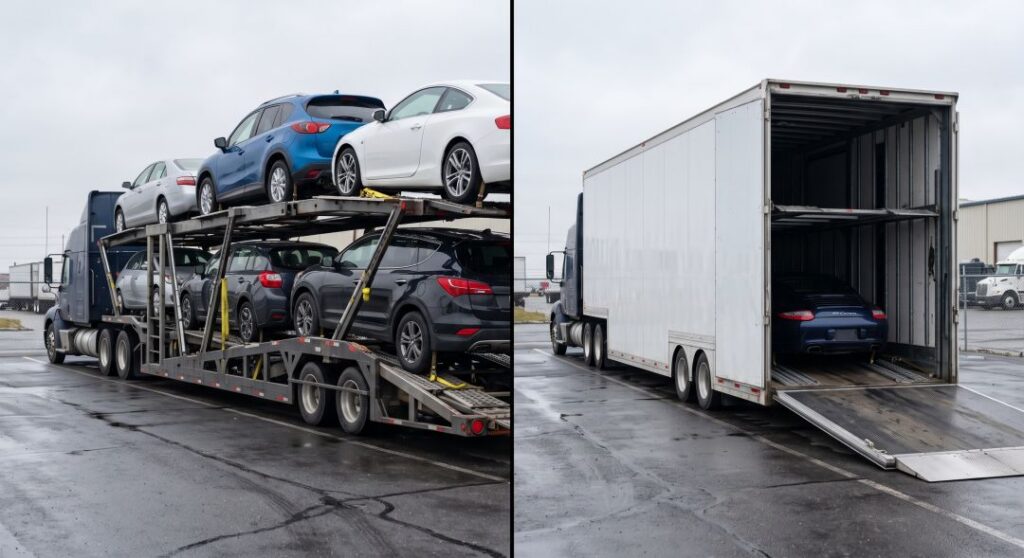
4. Open vs Enclosed Transport
This is the biggest single lever you control.
← swipe to see all columns →
| Open transport | Enclosed transport | |
|---|---|---|
| Cost | Baseline | 30% to 60% more |
| Exposure | Road debris, rain, dust, sun | Fully shielded |
| Capacity | Typically 7 to 10 vehicles | Typically 2 to 6 vehicles |
| Availability | Very high, most carrier capacity | Limited, longer booking lead time |
| Best for | Daily drivers, most household moves | Luxury vehicle, classic car, exotic cars |
Roughly nine out of ten vehicles move on an open carrier. It is the same equipment dealerships use to receive new inventory. Your car is exposed to weather and highway grit for a few days, which is the same thing that happens when it sits in a driveway.
An enclosed carrier earns its premium for a narrow group: a collector's car, a low-clearance sports car, anything where a rock chip is a four-figure repair. If you are moving a collector's car you already know it. For everyone else, open transport and a wash on arrival is the rational choice.
Our own coverage reflects that split. Cross Country Movers carries full coverage while a vehicle is in our possession, up to $100,000 on an open carrier and $500,000 in an enclosed one.
5. Door-to-Door vs Terminal-to-Terminal
Door-to-door means the truck comes as close to your address as legal and physically possible. Sometimes that is your driveway. Often it is a nearby shopping center lot, because an 80-foot rig cannot navigate a residential cul-de-sac.
Terminal-to-terminal means you drop the car at a regional lot and collect it from another. It can shave $50 to $150 off the price.
Here is my honest read: during a cross-country move, terminal service usually costs you more than it saves. You need transportation to and from both terminals, on days when you have a hundred other things happening, in a city you may not know yet. The savings evaporate the moment you pay for one rideshare across an unfamiliar metro.
Door-to-door is what most people should book. We offer both door-to-door and terminal delivery through our car shipping service, and we still recommend door for anyone in the middle of a household relocation.
6. Seasonality and Timing
Seasonality is real and it is predictable.
- Summer, roughly May through August: peak. Family moves, military relocations, and college schedules all collide. Expect the highest rates of the year.
- September through December: snowbird season. Southbound traffic toward Florida and Arizona tightens hard. Northbound capacity gets cheap.
- January through March: the slowest window outside snowbird lanes. Prices can sit 10% to 20% below peak on the same route.
- March through May: snowbird reversal. Northbound out of Florida gets expensive.
Direction matters too. More vehicles move West Coast to East Coast than the reverse in some seasons, and that imbalance shows up in your quote depending on which way you are heading. Midwest lanes tend to be steadier than either coast.
7. Booking Lead Time
Booking lead time is free money and almost nobody uses it.
- Cross-country routes: book 3 to 4 weeks out, 4 to 6 during peak
- 500 to 1,500 miles: 2 to 4 weeks
- Under 500 miles: 1 to 2 weeks
Booking inside 5 to 7 days of your desired pickup date typically costs 15% to 25% above market. Carriers who can dispatch on short notice charge for that flexibility, and they are right to.
A flexible pickup window is worth as much as lead time. Giving a carrier a 3 to 5 day window instead of a fixed date routinely saves 10% to 20%, because it lets the dispatcher slot you into a truck that is already going your way.
8. Pickup and Delivery Locations
Your pickup and delivery zone matters as much as total mileage. Two ZIP codes 2,000 miles apart can price hundreds of dollars differently depending on how easy each end is to reach.
Metro-to-metro on a major corridor is cheapest. Metro-to-rural costs more. Rural-to-rural on opposite sides of the country is the most expensive combination in the business.
If your pickup and drop-off locations are both awkward, ask about meeting the driver at a nearby retail lot with truck access. That single adjustment has saved our clients real money.
9. Fuel Costs and Surcharges
This is where 2026 diverges from the last few years, and it is worth its own section.
The 2026 Fuel Situation and Why Quotes Look Different
Car haulers burn diesel, and diesel has been brutal this year.
As of early August 2026, the national average on-highway diesel price sat around $5.35 per gallon, per the U.S. Energy Information Administration, which surveys roughly 400 retail stations weekly. Regular gasoline crossed $4.00 per gallon in the same period, up nearly 89 cents from a year earlier. You can track both through AAA's national fuel gauge.
That EIA diesel index is not trivia. It is the number written into most freight fuel-surcharge clauses. When it climbs, surcharges on your car shipping quote climb with it, automatically, whether or not anyone explains that to you.
There is a second signal worth knowing about. The IRS almost never adjusts mileage rates mid-year. It did in 2026. Effective July 1, the business standard rate jumped from 72.5 cents to 76 cents per mile, an off-cycle correction the agency attributed to rising fuel prices. You can confirm the current figure on the IRS standard mileage rates page.
When the federal government breaks its own annual schedule to raise the cost-of-driving benchmark, that tells you something about driving economics this year. It also reshapes a decision a lot of people make on autopilot.
Should You Just Drive It Instead?
Run the numbers before you assume driving is cheaper. In 2026, it frequently is not.
Take a 2,800-mile Los Angeles to New York move in a car getting 28 mpg.
← swipe to see all columns →
| Line item | Driving it yourself | Shipping it |
|---|---|---|
| Fuel (100 gallons at $4.00) | $400 | Included |
| Lodging (4 nights at $130) | $520 | $0 |
| Food on the road (5 days) | $250 | $0 |
| Tolls and parking | $80 to $120 | $0 |
| Out-of-pocket subtotal | $1,250 to $1,290 | $1,200 to $1,900 |
| 2,800 miles of wear, tires, depreciation | ~$880 at IRS rate | $0 |
| Five days of your time | Not free | Free |
| True total | $2,100+ | $1,200 to $1,900 |
Out of pocket, driving looks like a wash. Once you count the mileage you are putting on the car, it stops looking like one.
And that assumes one vehicle. Two-car households cannot drive both without splitting the family into separate cars for five days or paying for someone to fly back. That is where shipping stops being a comparison and becomes the only sane option.
Some people ship one and drive the other. That is a reasonable split, especially if one vehicle is newer. We walk through the full tradeoff in our guide on whether to drive or ship your car across country.
What about the alternatives people ask about? Towing behind a rental truck adds a tow dolly rental, a serious fuel penalty, and the stress of backing a loaded trailer. Moving a car by train is not a retail service most consumers can access on most routes. For students heading to school without a parent available to drive, professional vehicle shipping is usually the only workable answer, and many carriers offer student rates worth asking about.
Bundling Car Shipping With Your Household Move
Here is the piece that separates a moving-day car transport decision from shopping for auto transport in isolation.
When your vehicle and your household goods move through the same company, three things get easier.
1One schedule instead of two. Coordinating a separate auto broker against your movers means two dispatch systems, two windows, two phone trees. When both are handled together, your car and your furniture arrive on compatible timelines rather than three weeks apart.
2One point of accountability. If a delivery window slips, you call one company. Anyone who has been bounced between a moving company and a transport broker while standing in an empty apartment understands why this matters.
3Better use of storage. If your new place is not ready, both the vehicle and the household goods can wait in the same plan. Our storage service handles the household side, and vehicle timing gets built around the same date.
One important caution. Do not load personal items into the car you are shipping. Federal regulations govern what auto transporters may carry, most carrier insurance excludes personal belongings entirely, and added weight can push the load over legal limits. Empty the trunk. Our guide on how to prepare your car for shipping covers the full pre-pickup checklist.

Reading the Bill of Lading
The bill of lading is the single most important document in vehicle transport, and most people sign it without reading it.
It serves as your contract, your receipt, and your condition report. At pickup, the driver inspects the vehicle and records existing damage. You sign. At delivery, you inspect again against that same record.
Three rules:
1Inspect in daylight. Do not accept delivery at night if you can avoid it. Scratches hide in bad lighting.
2Note any new damage before you sign. Once you sign a clean delivery, your claim gets substantially harder.
3Photograph everything at both ends. Timestamped photos settle disputes that memory cannot.
If damage occurs, the bill of lading plus your photos are the claim. Nothing else carries the same weight. Our moving insurance page explains how coverage works across both vehicles and household goods.
How to Lower Your Car Shipping Cost
Practical levers, ranked roughly by how much they actually move the number:
- Choose open transport unless the vehicle genuinely warrants enclosed. This is a 30% to 60% swing.
- Give a flexible pickup window. A 3 to 5 day range instead of a fixed date saves 10% to 20%.
- Book 3 to 4 weeks ahead. Last-minute costs 15% to 25% more.
- Move off-peak. January through March, and late September through early November, are the softest windows on most lanes.
- Meet near a major corridor. If you are rural, driving 40 minutes to a metro pickup point can save more than the gas costs.
- Ask about student, military, and multi-vehicle discounts. Shipping two cars on one booking is almost always cheaper per vehicle.
- Verify before you save. Run any company's USDOT number through the FMCSA SAFER system and confirm active operating authority. A rock-bottom bid from an unverified operation is not a deal. The FMCSA's Protect Your Move resource explains the difference between a carrier and a broker, and why it matters.
One thing not on that list: chasing the cheapest quote. If a bid comes in 30% below everything else, that is not a discount, that is a number designed to win your booking before it gets revised upward. Reputable licensed & insured carriers price within a recognizable band of each other because they are all buying the same diesel.
Why Clients Choose Cross Country Movers for Vehicle Transport
Cross Country Movers is a direct interstate carrier, not a broker. We operate under USDOT 2552260 and MC-889368, hold a BBB A+ rating, and run our own equipment out of Tarzana, California.
That direct-carrier status is the practical difference. When you book with us, you are not buying a listing that gets posted to a load board for whichever truck bids lowest. You are booking the company that moves the vehicle.
What we bring to a cross-country move:
- Guaranteed flat price based on a detailed inventory list with no surprise fees or weight-based charges
- Experienced movers trained to handle fragile and bulky items with care and attention to detail
- Timely pick-up and drop-off respecting clients' schedules for all moves, local or cross-country
- Comprehensive services including packing, storage in temperature-controlled facilities, and car shipping
- Full-service international moving to over 150 countries including packing and customs documentation
That flat-price commitment matters more in vehicle transport than people realize, because the industry's most common complaint is a quote that changes after the car is already on a truck. If you are relocating abroad rather than domestically, our international moving service covers vehicles and household goods under the same documentation process.
For anyone comparing methods before committing, our breakdown of the best way to ship a car across the country goes deeper on transport types, and our state-to-state moving route guides cover corridor-specific timing.
Putting It All Together
Vehicle transport during a cross-country move is usually a $1,200 to $1,900 decision, and most of that number is set before you ever request a car shipping quote. Route, timing, lead time, and carrier type do the heavy lifting.
Book early. Stay flexible on the pickup date. Choose open transport unless your car genuinely needs otherwise. Verify operating authority before you hand over keys. Then fold the vehicle into the same moving budget and the same schedule as the rest of your household goods instead of managing it as a separate project.
If you want a firm number for your specific route, you can request a free estimate covering both your vehicle and your household move. For broader budget planning, our moving budget guide puts the car line item in context with everything else.
Key Takeaways
- Cross-country vehicle transport typically costs $1,200 to $1,900 for an operable sedan on an open carrier. Budget $1,500 per vehicle as a working figure.
- Per-mile rates drop as distance grows. Coast-to-coast runs $0.45 to $0.70 per mile, versus $1.40 to $2.20 under 500 miles.
- Open transport handles roughly nine of ten vehicles. Enclosed adds 30% to 60% and is worth it only for a classic car, luxury vehicle, or exotic cars.
- 2026 fuel costs are pushing quotes up. EIA on-highway diesel near $5.35 per gallon feeds directly into carrier fuel surcharges.
- Driving is rarely the cheaper option anymore. Out-of-pocket costs run close, but adding wear at the IRS rate of 76 cents per mile puts driving above $2,100 on a 2,800-mile trip.
- Book 3 to 4 weeks out with a flexible window. Combined, lead time and flexibility save 25% or more against a last-minute fixed-date booking.
- Verify the USDOT number before you book. Confirm active operating authority through FMCSA SAFER, and never load personal items into a shipped vehicle.
Frequently Asked Questions
- How much does it cost to transport a vehicle when moving cross country?
Budget $1,200 to $1,900 for an operable sedan on an open carrier across 2,000+ miles. SUVs and trucks add $150 to $400. Enclosed transport adds 30% to 60%. The national average across all distances sits near $1,200, but cross-country moves land above it because of total mileage.
- Is it cheaper to ship a car or drive it across the country?
Out of pocket, they are close. Counting fuel, lodging, food, and tolls, driving 2,800 miles runs roughly $1,250 to $1,290. But once you add wear and depreciation at the IRS rate of 76 cents per mile, the true cost of driving exceeds $2,100, above most shipping quotes. Shipping also returns five days of your life.
- How long does cross-country vehicle shipping take?
Most interstate coast-to-coast deliveries take 7 to 10 days from pickup, with a 1 to 5 day pickup window before that. Shorter routes run faster. Weather, road closures, and mountain passes add time. Our guide on how long it takes to ship a car breaks it down by distance.
- Should I pay a deposit before my car is picked up?
Ask directly about deposit terms before booking, and get the answer in writing. Some operators require money up front, some bill on delivery, and no upfront deposit arrangements exist. Also ask whether real-time tracking is available and how the delivery type is confirmed. Any company unwilling to put payment terms in writing is telling you something.