Best International Moving Companies in the US (2026 Guide)
A 2026 guide to international moving companies in America. Compare top international movers, verify FMC licensing, weigh sea vs. air shipping, see real cost ranges, and get a free consultation. [...]<p><a class="btn btn-secondary understrap-read-more-link" href="https://crosscountrymovers.com/resources/best-international-moving-companies-us-2026-guide/">Read More...</a></p>
The strongest international moving companies in the US tend to be full-service providers that are licensed by the Federal Maritime Commission and handle export packing, customs clearance, ocean or air freight, and door-to-door service under one roof. For most American households planning an international relocation, a licensed and bonded international moving company with transparent pricing and a vetted destination network is generally a safer choice than a bargain broker or a piecemeal freight booking.
Use this international movers guide to tell a well-run international moving company from a risky one, compare the providers worth evaluating, weigh sea against air freight, understand 2026 costs, and follow a clear international moving checklist. Whether you are leaving New York, departing Manhattan for Europe, or shipping from anywhere else in the United States, the same fundamentals apply.
Key Takeaways (TL;DR)
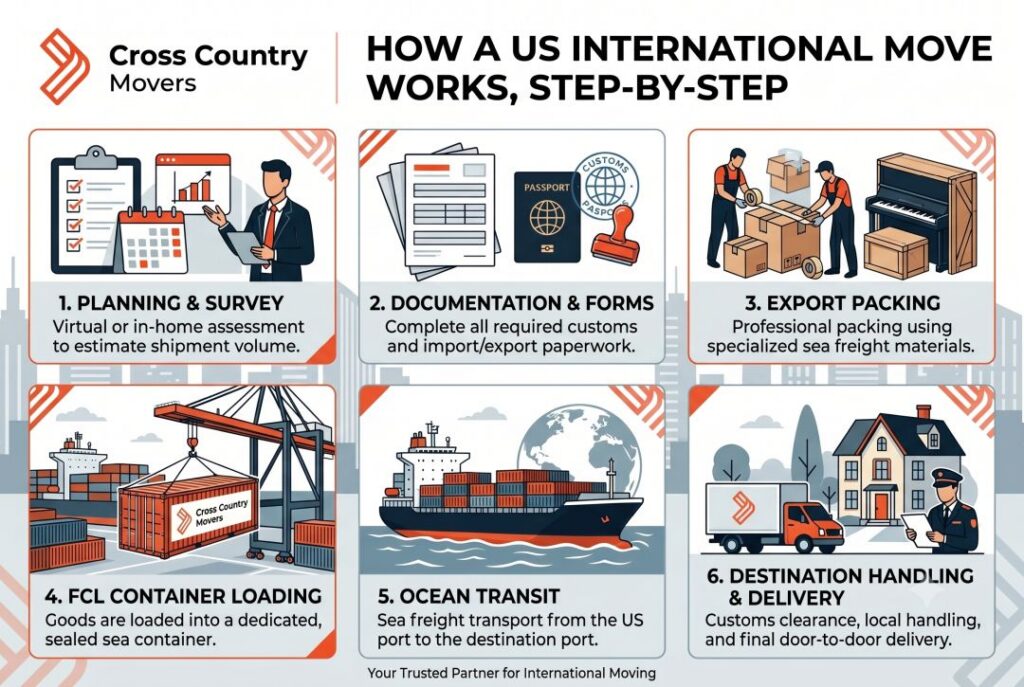
Image suggestion: [Suggested visual: hero image of a full container load being loaded at a US port, or an infographic, "How a US international move works, step by step."]
- Licensing comes first. A US company that arranges your overseas ocean shipment generally must hold an Ocean Transportation Intermediary (OTI) license from the FMC. Confirm any company's status on the FMC's licensed OTI list.
- A USDOT number is not the same as an FMC license. USDOT/MC numbers cover domestic trucking through the FMCSA. The ocean portion of international moving is regulated separately by the Federal Maritime Commission.
- Sea freight is usually cheapest; air freight is fastest. A full container load or a shared container suits most household moves. Air freight makes sense for urgent or small shipments.
- Budget a wide range. Independent estimates put a typical international move from the US at roughly $6,500 to $16,500 in 2026, depending on destination, volume, and method.
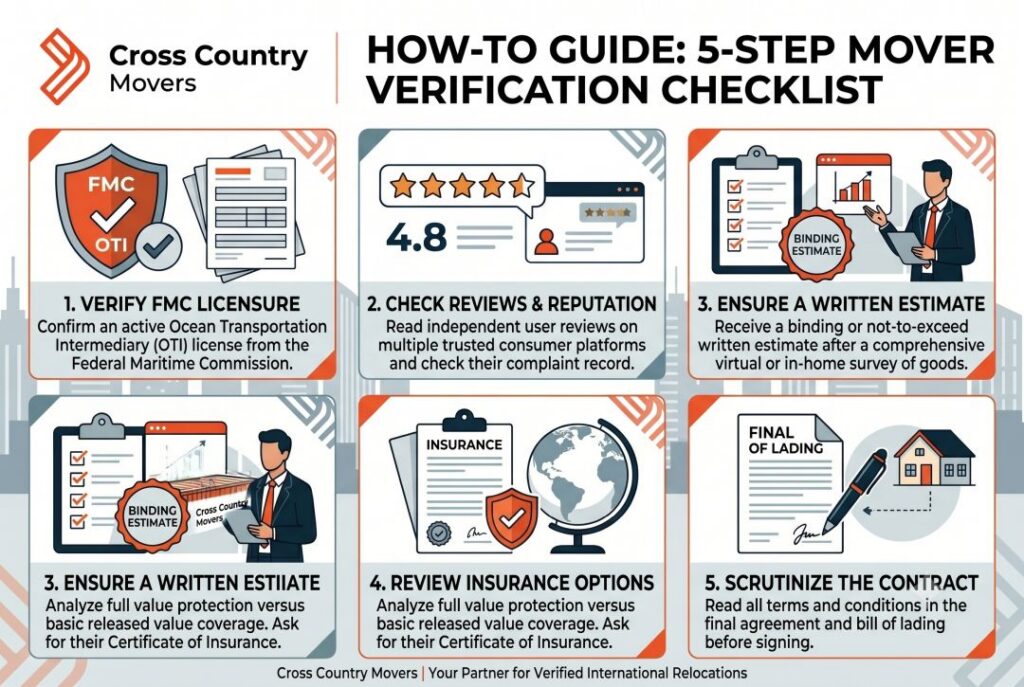
- Verify three things before paying: license and insurance (active FMC license, full liability coverage), and a written international moving estimate.
How to Verify an International Moving Company (Do This First)
Before comparing international moving quotes, confirm the company is legitimate. This takes a few minutes and protects your deposit.
- Search the FMC OTI list. Look up the legal company name on the FMC licensed OTI database and confirm the license is active, not revoked, suspended, or surrendered. The FMC publishes status changes on its OTI License Status Changes page.
- Check domestic authority too. For the trucking leg, look up the USDOT or MC number on the FMCSA SAFER system and review the safety and complaint record.
- Confirm license and insurance. A licensed and bonded ocean transportation intermediary carries the required FMC bond. Ask for full replacement-value liability coverage and read the exclusions.
- Look for industry credentials. Membership in the International Association of Movers or FIDI is a positive signal of professional standards.
- Read recent third-party reviews. Scan the Better Business Bureau, Google, and Trustpilot, watching how each company handles complaints.
Image suggestion: [Suggested visual: a "5-step mover verification checklist" graphic, well suited to HowTo schema.]
What Full-Service International Moving Includes
A true full-service international moving company manages the entire chain, so you are not stitching together separate vendors for packing, shipping, and transport. Look for these services.
- Full packing service and packing materials: professional packing and loading using export-grade moving supplies, including reinforced cartons and waterproof wrapping.
- Custom crating and special packing services: custom crates for moving specialty items such as pianos, antiques, and art.
- Storage services: secure storage and temperature-controlled facilities for items waiting on a shipment date.
- Shipment tracking: tracked international moving shipments so you can follow progress from port to port.
- Delivery and unpacking: door-to-door service, sometimes described as home-to-home international moving, including unpacking services at the destination.
- A dedicated moving coordinator: one international moving coordinator who manages shipping logistics from pickup to final delivery.
- Car shipping: integrated overseas vehicle transport so household goods and a vehicle move through one provider.
Image suggestion: [Suggested visual: icon row of included services, from packing and loading to delivery and unpacking.]
International Moving Companies Worth Evaluating in 2026
The companies below are organized by the type of move each tends to handle well, based on publicly available information. This is editorial guidance, not a ranking of service quality, and listing a company is not an endorsement. Re-verify each company's current FMC license, insurance, and complaint history before you book.
Cross Country MoversStrong for Full-Service Moves
150+ CountriesSea & AirFlat-Rate PricingUSDOT 2552260 / MC-889368
Cross Country Movers markets full-service international moving to over 150 countries, including packing and customs documentation, by sea and air. Its stated value propositions include a guaranteed flat price based on a detailed inventory list with no surprise fees or weight-based charges, timely pick-up and drop-off that respect clients' schedules for all moves whether local or cross-country, and experienced movers trained to handle fragile and bulky items with care and attention to detail. Its comprehensive services include packing, storage in temperature-controlled facilities, and car shipping. Domestic operating authority is USDOT 2552260 / MC-889368; if the FMC ocean license matters for your shipment, confirm current OTI status on the FMC list before booking.
May suit: households that want flat-rate pricing and a single coordinator from pickup to delivery.
International Van LinesWorth a Look for Flexible Quotes
USDOT 2293832Broker + CarrierBBB AccreditedOnline Cost Calculator
International Van Lines is a long-established international moving company (USDOT 2293832) that offers ocean and air freight and publishes an online cost calculator. One caveat: it operates as both a broker and a carrier, acting as a carrier in a handful of states and brokering to local partners elsewhere, and some complaints trace back to subcontracted movers. On the positive side, it is BBB accredited, and FMCSA complaints have declined year over year.
May suit: price comparison shoppers who confirm who will actually perform the move.
Sunset International ShippingWorth a Look as an International Specialist
FMC #023860N (self-reported)Sea & AirCustom CratingOverseas Vehicles
Sunset International Shipping focuses specifically on international relocation and self-reports an FMC license, #023860N, on its website, offering sea and air shipping, custom crating, and overseas vehicle shipping. Confirm that license is active on the FMC list before relying on it.
May suit: buyers who want a dedicated international-only specialist and custom crating.
Schumacher CargoWorth a Look for Cars Plus Household Goods
NVOCC (self-described)Since 1977Vehicles + HouseholdVerify Reviews
Schumacher Cargo, based in Los Angeles since 1977, describes itself as a licensed NVOCC and combines international vehicle shipping with household goods. Reviews are mixed: its BBB profile includes complaints about delivery timelines changing after payment, so read recent feedback and confirm timelines and refund terms in writing.
May suit: moves that include a personal vehicle, for buyers who vet timelines carefully.
Allied Van Lines and North American Van LinesWorth a Look for Large or Corporate Moves
Major Van LinesGlobal Agent NetworkVerify FMC License
Both Allied Van Lines and North American Van Lines are major US van line brands with international divisions and broad agent networks, which can help with large or corporate relocations. We did not independently verify their FMC OTI numbers for this guide, so confirm current licensing on the FMC list before booking.
May suit: large households and employer-managed relocations.
Other International Movers You May Come Across
Beyond the companies above, several national van lines and specialists appear frequently in international moving research. Listing a company here is not an endorsement, and you should verify each one's FMC license and insurance before booking.
- Major national van lines: United Van Lines, Mayflower (Mayflower Transit), American Van Lines, and National Van Lines are long-running US brands with international and shipping and transport operations.
- International and container specialists: Seven Seas Worldwide, Viking International Movers, and JK Moving Services handle overseas household goods, ranging from full container load service to shared-container shipping.
- Self-service and container options: U-Haul and BLUEmove appeal to budget-focused movers who want to pack their own container.
- Regional and metro movers: FlatRate, Good Greek Moving and Storage, Manhattan International Moving, and United International serve specific regions or metros, such as New York and Manhattan, and may broker the ocean leg through a licensed ocean transportation intermediary.
Image suggestion: [Suggested visual: short embedded video, "How we pack for an overseas move."]
Quick Comparison Table
| Company | Often Chosen For | Sea Freight | Air Freight | Car Shipping | Verify Before Booking |
|---|---|---|---|---|---|
| Cross Country Movers | Full-service | Yes (full container load + shared) | Yes | Yes | FMC OTI status |
| International Van Lines | Flexible quotes | Yes | Yes | Yes | Broker vs. carrier for your route |
| Sunset International Shipping | International specialist | Yes | Yes | Yes | FMC #023860N active status |
| Schumacher Cargo | Cars + household goods | Yes | Limited | Yes | Recent reviews, delivery terms |
| Allied Van Lines | Large/corporate | Yes | Yes | Yes | FMC OTI status |
| North American Van Lines | Large/corporate | Yes | Yes | Yes | FMC OTI status |
Services and licensing change. Confirm details directly and on the FMC and FMCSA databases before booking.
Types of International Moving Services
Understanding the shipping methods helps you read international moving quotes accurately.
Ocean Freight (Sea)
Ocean freight is the most common and affordable method for full household moves, with two container options.
- Full Container Load (FCL): a dedicated 20-foot or 40-foot container for your belongings only, loaded once and sealed until the destination port.
- Less than Container Load (LCL): your items share container space, which lowers cost for smaller moves but can add time for consolidation.
Popular international moving routes from the US run roughly 14 to 21 days to Europe, 21 to 35 days to Asia, and 28 to 42 days to Australia and New Zealand, before customs clearance and local delivery.
Air Freight
Air freight is the fastest option, with transit as short as 3 to 10 days. It typically costs roughly double sea freight, so it is best for urgent timelines, essential items, or smaller shipments. Many households use a hybrid approach: a small air shipment of essentials arrives first while the bulk of the home travels by sea.
Overseas Vehicle Shipping (Car Shipping)
Two methods apply. Roll-on/Roll-off (RoRo) drives the vehicle onto a specialized vessel and is usually the most affordable. Container shipping encloses the car for added protection. Cross Country Movers offers both through its car shipping service.
Image suggestion: [Suggested visual: side-by-side diagram, "FCL vs. LCL vs. Air freight," with cost and speed icons.]
How Much Does an International Move Cost in 2026?
Independent 2026 estimates put a typical door-to-door international move from the US at roughly $6,500 to $16,500, though the final figure varies widely.
The biggest cost drivers are:
- Volume and weight of your international shipment (usually the largest factor).
- Destination and route, since some ports and countries cost far more to reach.
- Shipping method, with air freight running roughly twice the price of sea freight.
- Services added, such as full packing service, storage services, car shipping, and full liability coverage.
- Timing, since peak season (roughly May through August) can raise rates.
Shared-container shipping is generally the most economical way to move a small home, while a full container load to a distant country sits at the higher end. Use an online cost calculator for a ballpark, then request a formal international moving estimate after a survey, and compare itemized international moving quotes from at least three licensed movers.

International Moving Checklist and Timeline
A realistic moving timeline keeps an international relocation on track. A simple international moving checklist looks like this.
- 8 to 12 weeks out: verify licensing, request a free consultation, and gather international moving quotes.
- 6 to 8 weeks out: book your international moving company, schedule the survey, and confirm your shipping method.
- 4 to 6 weeks out: declutter, plan storage if needed, and begin gathering customs forms and required documents.
- 2 to 4 weeks out: confirm packing and loading dates, finalize car shipping, and review your inventory.
- Moving week: professional packing, loading, and pickup, with shipment tracking activated.
- At destination: customs clearance, delivery and unpacking, and final placement.
Image suggestion: [Suggested visual: downloadable "International moving checklist and timeline" graphic.]
Customs and Immigration for International Movers
International moving carries compliance steps that domestic moves do not.
FMC licensing and bonding. A US company arranging international ocean transport of household goods generally must hold an FMC OTI license and post a bond. The FMC can suspend or revoke licenses, so confirm the status is current.
Customs documentation. Your mover should prepare export paperwork, complete customs forms, and coordinate with customs brokers for customs clearance at your destination. Many countries allow duty-free import of used household goods for people establishing residency, subject to international regulations and documentation such as proof of residency and a visa. For more on the paperwork side, see this guide on the documents and permits required for a move.
Cargo insurance. Choose full replacement-value liability coverage over basic protection, and review the claims process. You can compare protection levels on the moving insurance page.
Prohibited and restricted items. Hazardous materials, flammable liquids, perishable food, live plants, firearms, and certain medications are commonly restricted. Rules vary by country.
Image suggestion: [Suggested visual: "Customs and immigration checklist for international movers" infographic.]
Why Many Households Choose a Full-Service International Moving Company
For many American households handling an international relocation, a full-service, flat-rate provider removes the parts most likely to go wrong, and it supports expat relocation solutions end to end.
- One accountable moving coordinator manages packing, freight, customs, and delivery.
- Flat-rate pricing built from a detailed inventory can replace vague estimates.
- Sea and air flexibility lets you balance cost and speed.
- A destination network handles overseas customs clearance and last-mile delivery.
- Integrated extras such as professional export packing, secure storage, and car shipping keep the move with one provider.
To see how a flat-rate overseas relocation is structured, the international moving services overview lays out each stage, and the 2026 best long-distance and cross-country movers guide offers a broader comparison.
Conclusion
Choosing among international moving companies in the US comes down to matching a licensed and bonded, full-service provider to the specifics of your move. Verify FMC licensing first, insist on transparent pricing and full liability coverage, and pick the shipping method that fits your budget and timeline.
To compare options or get a free consultation and an all-inclusive flat-rate estimate, explore the international moving services overview or request a free quote.
About the Author
This guide was prepared by the Cross Country Movers editorial team, drawing on experience in international moving, shipping logistics, customs documentation, and door-to-door relocations. Company licensing details cited here reflect publicly available information at the time of writing and should be re-verified on the FMC and FMCSA databases. Competitor names are listed for buyer research only and are not endorsements. Content is reviewed and refreshed regularly.
Primary sources: U.S. Federal Maritime Commission (FMC); FMCSA / SAFER; Better Business Bureau; Sirelo and International Van Lines 2026 cost data. Last reviewed: June 2026.
Frequently Asked Questions
- What is the best international moving company in the US?
There is no single best international moving company for everyone. The right choice depends on your shipment size, destination, budget, and timeline. For full-service international moving and shipping with flat-rate pricing, a licensed full-service provider is a reasonable starting point. Always confirm the FMC license and insurance before booking.
- How much does it cost to move internationally from the US?
Independent 2026 estimates put a typical door-to-door international move from the US at roughly $6,500 to $16,500, depending on volume, destination, method, and added services. Shared-container sea freight is usually the cheapest method. Request itemized international moving quotes for an accurate figure.
- How long does an international move take?
Ocean freight transit usually takes about 2 to 6 weeks depending on destination, plus 1 to 2 weeks for customs clearance and local delivery. Air freight cuts transit to roughly 3 to 10 days. Confirm current timelines with your moving coordinator.
- How do I know if an international mover is legitimate?
Verify the company on the FMC's licensed OTI list and confirm the license is active. Check domestic authority on FMCSA SAFER, confirm full liability coverage, get a written international moving estimate, and read recent third-party reviews.